How to Set Up a Home Pottery Studio in the UK — What You Actually Need
Setting up a pottery studio at home is more realistic than you might think. You don't need a dedicated barn or converted outbuilding—many potters work successfully in spare bedrooms, garages, or garden sheds. The key is understanding what actually matters: adequate space for a wheel or hand-building, proper ventilation to manage clay dust and kiln fumes, sufficient electrics for a kiln, and permission from your landlord or local authority. This guide walks you through each requirement and shows you how to scale your setup as your practice grows.
Space: How Much Do You Really Need?
A functional home pottery studio needs between 30 and 60 square metres. That sounds like a lot, but it breaks down simply: a pottery wheel takes up about 1.2 metres squared, a kiln needs a clear radius of at least a metre around it, and you'll want bench space, clay storage, and somewhere to dry work in progress.
If you're starting with hand-building only—coil, slab, pinch techniques—you need far less. A dining table, a shelf for tools, and a drying rack will do. You can literally begin in a bedroom corner.
A pottery wheel, however, demands more room. Not just for the wheel itself, but for the space around it where you'll need to move, reach, and store trimming tools and water buckets. Cramped wheels lead to bad posture and poor work. If you're planning a wheel from the start, a spare bedroom or garage is the realistic minimum.
Kilns are the space problem. A small electric kiln (around 30 litres capacity) might sit in a garage corner, but many councils want kiln rooms to have dedicated ventilation ducting and fire-resistant walls. Some potters position kilns in sheds or outbuildings to avoid this altogether. We'll cover planning permission below, but space-wise, assume the kiln is your anchor. Everything else organises around it.
Electrics: What Your House Can Handle
Pottery wheels draw 1–2 kilowatts when running. Most UK circuits handle that fine. Kilns are the real load. A standard domestic kiln draws 3–6 kilowatts, sometimes more. Your home's fuse box probably supplies 60–100 amps total. A kiln drawing 6 kW at full temperature can exceed what a standard ring circuit can deliver safely.
Here's what to check:
- Get an electrician to assess your consumer unit and tell you what capacity is available.
- A new dedicated circuit to the kiln is usually necessary. Budget £200–£400 for an electrician to install one.
- If you live in a rented property, you'll need landlord consent. Most landlords won't approve a dedicated kiln circuit without professional assessment first.
Don't underestimate this step. Kilns must run on their own circuit. Sharing with your washing machine or heating system invites tripped breakers, incomplete firings, and potential safety issues.
Ventilation: More Critical Than You Think
Clay dust isn't as dramatic as silica in traditional ceramics, but repeated exposure matters. Wheel-thrown work generates fine dust when you're centering clay and trimming leather-hard pieces. Hand-building is gentler. Either way, you need to move air.
A simple extractor fan pulling air from the studio and out through a wall or window is the baseline. Position it opposite your main work area. Kilns themselves need separate venting—flue gases include water vapour and trace fumes that condense on walls and windows if not exhausted outside. Electric kiln venting is less critical than gas kiln venting, but still important.
Budget £80–£150 for a decent ducted extractor fan and another £100–£200 if the kiln needs a dedicated vent. If you're renting, portable fans and window-mounted extractors can work temporarily, though permanent ducting is better long-term.
Planning Permission: Don't Assume You Don't Need It
This is where many home potters stumble. You likely don't need planning permission if:
- You're renting the space and have explicit landlord consent.
- You're not running a commercial business (selling regularly or working for clients).
- You're not installing a kiln in a way that changes your building's exterior (roof vents, exhaust ducting visible from the street).
You may need it if:
- You're modifying walls, floors, or roof structure.
- You're installing a kiln that requires structural changes or dedicated ventilation ducting.
- You live in a conservation area or listed building.
- You're working commercially and the studio looks like a business premises from outside.
Contact your local planning authority or check their online guidance first. A quick phone call often clarifies things without lodging a formal application. Better to ask than discover later that you've breached conditions.
Budget: A Realistic Phased Approach
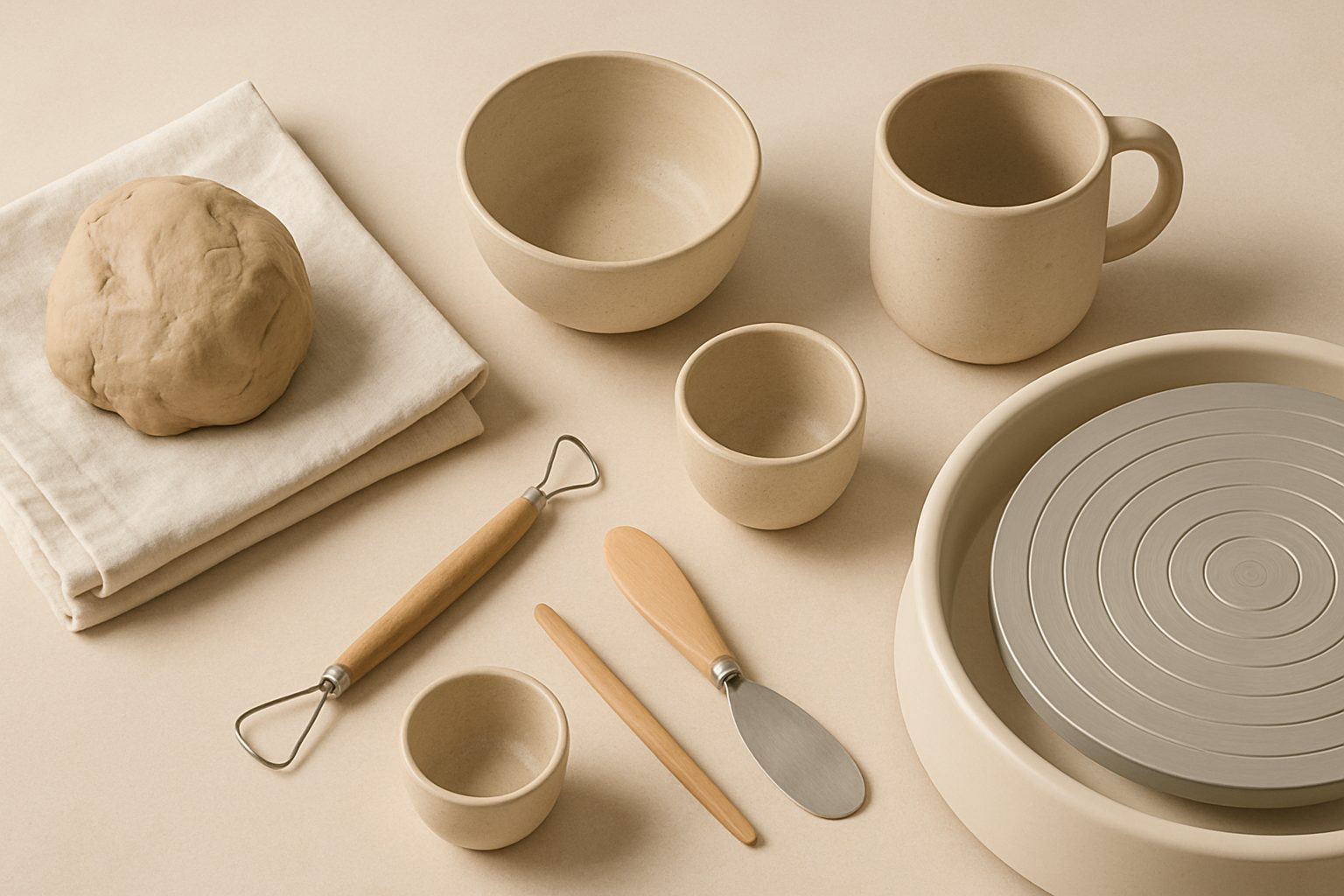
Phase 1: Hand-Building (£200–£500) Workbench or table, clay, basic hand tools, bucket, sponge, cutting wire. This is genuinely minimal.
Phase 2: Wheel and Basics (£500–£1,500) Add a pottery wheel (£200–£600 for a decent tabletop unit), bat system, trimming tools, apron. You still need the room—a spare bedroom or corner of a garage—but no major infrastructure.
Phase 3: Small Kiln (£2,000–£5,000) A small electric kiln (Skutt, Paragon, or similar) costs £1,200–£2,500. Add a dedicated circuit (£300–£400), basic kiln furniture and stilts (£300–£500), and extraction for the kiln (£150–£200). This is where a proper studio space becomes non-negotiable.
Most home potters work at Phase 2 for years. The kiln is a serious investment, and buying pottery time at a studio first (£5–£10 per hour) lets you test whether you'll actually use it regularly.
Making It Work
The secret to a functional home studio is organisation. Clay is sticky and dust goes everywhere. Designate zones: wet work near water, dry storage away from dust sources, the kiln in a separate, well-ventilated space if possible. Invest in shelving, lidded buckets, and a banding wheel trolley to contain the chaos.
Start small, build incrementally, and talk to your local authority before installing a kiln. A home pottery studio is entirely feasible—hundreds of UK potters run active practices in converted garages and spare rooms. Just plan the space, the electrics, and the permission first.
More options
- Pottery Wheels (Electric & Tabletop) (Amazon UK)
- Home Pottery Kilns (Compact & Beginner) (Amazon UK)
- Pottery Clay (Stoneware & Earthenware Bags) (Amazon UK)
- Pottery Tool Kits & Hand Tools (Amazon UK)
- Pottery Glazes (Brush-On & Dipping) (Amazon UK)